1. Introduction to Parts of Speech
Chapter focus: parts of speech, word families, and grammar labels.
How to study this lesson
Read the explanation first, then say the examples aloud. Change one detail in each example, such as the subject, time, or place. Complete the practice without looking back and use the answer key to understand the reason for each answer. Finish by writing two sentences about your own life or city.
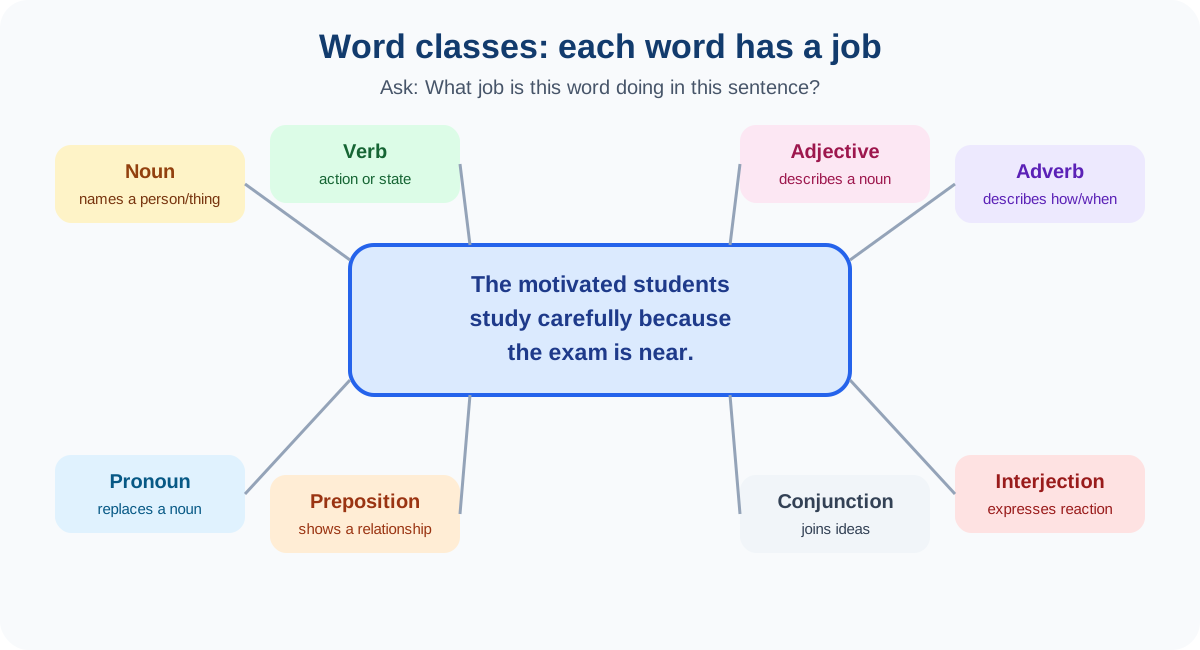
Figure 1. Use the word-class map to ask what job each word performs. The Bengali labels are a support, not a replacement for the English examples.
A part of speech is a group of words classified by the job it performs in a sentence. Traditional grammar commonly identifies nouns, pronouns, verbs, adjectives, adverbs, prepositions, conjunctions, and interjections. A word can belong to different classes in different sentences.
The main word classes
| Word class | Main job | Example |
|---|---|---|
| Noun | names a person, place, thing, or idea | student, Dhaka, pollution, freedom |
| Pronoun | replaces a noun | she, they, which, someone |
| Verb | expresses an action, event, or state | study, increase, seem |
| Adjective | describes a noun or pronoun | large, useful, environmental |
| Adverb | modifies a verb, adjective, adverb, or whole clause | carefully, very, fortunately |
| Preposition | shows a relationship, often of time, place, or direction | in, at, from, because of |
| Conjunction | connects words, phrases, or clauses | and, but, although |
| Interjection | expresses a brief feeling or reaction | Oh! Wow! |
Consider the sentence: The highly motivated students completed the difficult task carefully because the deadline was close. Students and task are nouns; completed and was are verbs; motivated and difficult are adjectives; highly and carefully are adverbs; because is a conjunction; and the is a determiner. Determiners such as a, an, the, this, and many are also important even though they are often taught separately.
Word families for IELTS
Academic English frequently changes one root word into several forms: educate (verb), education (noun), educational (adjective), and educationally (adverb). Build vocabulary in families, but check the spelling and the grammar of each form. In a Task 1 sentence, write The percentage increased, not The percentage increase when a verb is required.
Practice
Identify the bold word class: (a) The rapid growth created pressure. (b) People adapt to change. (c) The policy was implemented gradually. (d) Although the plan was expensive, it was effective.
Answers: (a) adjective, (b) verb, (c) adverb, (d) conjunction.
IELTS transfer task
Write a short four-sentence response about an IELTS topic such as education, health, transport, technology, or the environment. Use at least two examples of the target grammar from this chapter. Underline those examples, then check that every sentence has a clear subject, a correct verb, and a meaning that is easy to understand.
References
Deep lesson: word jobs, not word labels
A word class tells you the job a word is doing in this sentence. The same spelling can change class. In I work every day, work is a verb. In I have a lot of work, work is a noun. This is why you should analyse the sentence, not memorise a word as permanently belonging to one class.
| Job | Question to ask | Example | Bengali support |
|---|---|---|---|
| Noun | Who or what? | Education changes lives. | নাম/ধারণা |
| Verb | What happens or exists? | Education changes lives. | কাজ/অবস্থা |
| Adjective | Which one or what kind? | Public education matters. | গুণ/বর্ণনা |
| Adverb | How, when, where, or how much? | It changes lives rapidly. | কাজের ধরন |
| Pronoun | Which noun is replaced? | It changes lives. | সর্বনাম |
| Preposition | What relationship? | access to education | সম্পর্ক |
| Conjunction | How are ideas joined? | Education matters because it creates opportunity. | সংযোগ |
Twelve examples to study
- Students (noun) learn (verb) quickly (adverb).
- The (determiner) new (adjective) library opened yesterday.
- They (pronoun) use it for (preposition) research.
- The programme is extremely useful.
- Although the course is demanding, it is practical.
- Research can be a noun: Researchers research problems.
- Increase is a noun in an increase, but a verb in prices increase.
- Online can describe a noun in online classes or an activity in study online.
- The rapid (adjective) growth (noun) affected housing.
- The city acted responsibly (adverb).
- Wow! is an interjection, but it is unsuitable for a formal essay.
- To reduce pollution, governments need effective policies.
Word-family ladder
Build four sentences from one root: educate (verb), education (noun), educational (adjective), educationally (adverb). Example: Schools educate children. Education improves opportunity. Educational resources must be affordable. The policy is educationally valuable. Do not assume every -ly word is an adverb or every -tion word is spelled predictably; check the form in a dictionary.
Common errors and corrections
Wrong: The government should provide free educate. Right: The government should provide free education. Wrong: People can easy access the service. Right: People can access the service easily. Wrong: Many student are benefit from it. Right: Many students benefit from it. Wrong: The city made a rapidly improvement. Right: The city made a rapid improvement.
Practice with reasons
A. Label the bold word: The policy significantly reduced traffic. Answer: policy is a noun, significantly is an adverb, reduced is a verb, and traffic is an uncountable noun.
B. Choose: The government made a (decide/decision) to (improve/improvement) transport. Answer: decision and improve. The article a needs a countable noun; to needs a base verb.
C. IELTS task: Write three sentences about education. Use one noun, one adjective, one adverb, one connector, and one verb. Check the job of every target word.
Professor's explanation: how to think about this grammar
Do not begin by memorising a definition. Begin by asking three questions: What job does this form do? What meaning does it add? Where does it go in the sentence? Bengali and English often arrange information differently, so direct translation can create mistakes. Build the English pattern first, then attach your idea to it.
Bengali learner warning
Many Bengali speakers understand the meaning of an English sentence but omit a small grammar word because Bengali does not always need the same word. English normally needs a clear subject and a finite verb. For example, say The number of students is increasing, not Number of students increasing. Treat articles, auxiliary verbs, plural endings, and prepositions as part of the pattern, not as optional decoration.
Three-step study method
Step 1 — Notice: underline the target form in every example. Step 2 — Control: replace only one part of the example, such as the subject or time. Step 3 — Communicate: use the form in a short answer about education, health, transport, technology, or the environment. If you cannot explain why you chose the form, return to Step 1.
Practice ladder
Level 1: Recognition. Find the target form and name its job. Level 2: Controlled production. Complete or correct a sentence using the pattern. Level 3: IELTS production. Write a short paragraph or speak for one minute. At Level 3, clarity is more important than using many different forms.
Revision checklist
Before moving on, ask: Can I explain the form in one simple sentence? Can I make a positive, negative, and question form where relevant? Can I use it with a past and a present example? Can I recognise the most common Bengali-speaker error? Can I use it naturally in one IELTS answer?