10. Conditional Sentence
Chapter focus: zero, first, second, third, mixed, and alternative conditional forms.
How to study this lesson
Read the explanation first, then say the examples aloud. Change one detail in each example, such as the subject, time, or place. Complete the practice without looking back and use the answer key to understand the reason for each answer. Finish by writing two sentences about your own life or city.
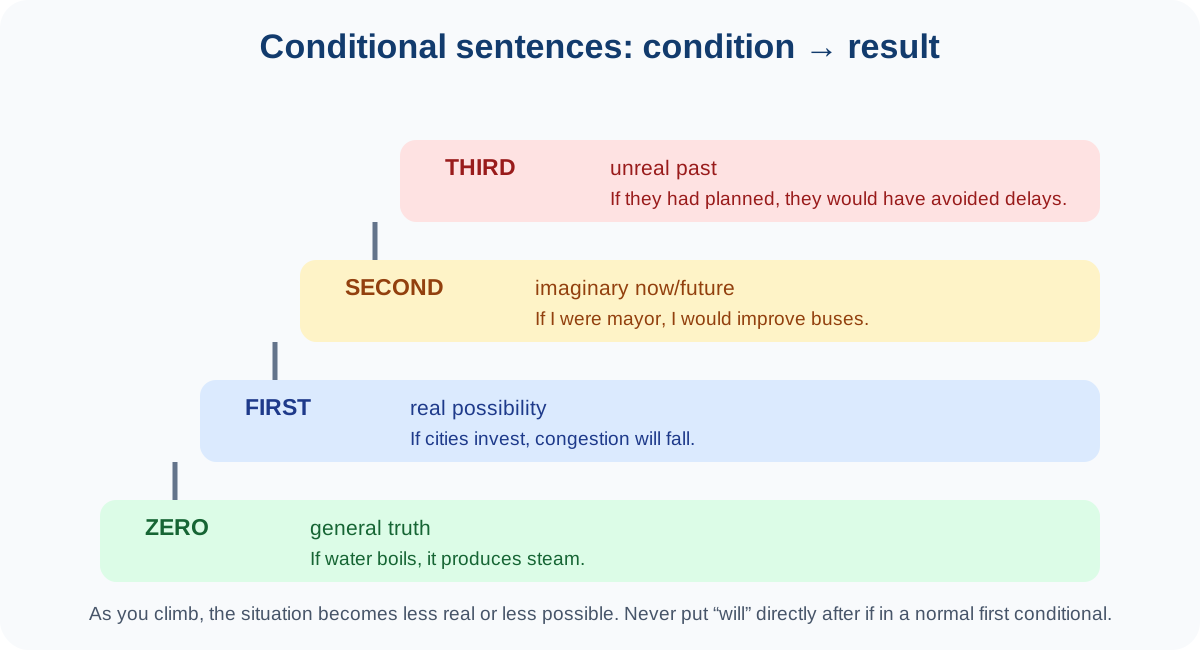
Figure 4. The four conditional patterns move from general truth to an unreal past.
A conditional sentence links a condition with a result. The if-clause gives the condition and the main clause gives the result. The clauses can change order: If governments invest, services improve and Services improve if governments invest. A comma is normally used when the if-clause comes first.
Main conditional patterns
Zero conditional describes general truths: If water reaches 100°C, it boils. Use present simple in both clauses.
First conditional describes a real or possible future result: If the government invests in rail, congestion will decrease. Use present simple after if, not will: If the policy succeeds, not usually If the policy will succeed.
Second conditional describes an unlikely or imaginary present/future situation: If I were the mayor, I would improve bus services. In formal English, were can be used with all subjects in the phrase If I were….
Third conditional describes an unreal past and its imagined result: If the city had planned better, it would have avoided the problem. The condition uses had + past participle; the result uses would have + past participle.
Mixed conditionals connect different times: If the city had invested earlier, it would have better transport now. Use them only when the time relationship is clear.
Other expressions include unless (if not), provided that, as long as, and even if. Unless already contains a negative meaning: Unless the plan changes, costs will rise; do not write unless it does not change when you mean the same thing.
IELTS use
Conditionals are useful for recommendations and consequences in Task 2: If schools teach media literacy, young people may evaluate online claims more carefully. Do not force them into every paragraph. A correct first conditional is more valuable than a complex mixed conditional used incorrectly. [2]
Practice
Complete the sentences: (a) If people used less plastic, the environment ___ (benefit). (b) If I ___ (be) responsible, I would fund public libraries. (c) If the company had checked the data, it ___ (avoid) the error.
Answers: (a) would benefit for an imaginary situation, or will benefit if the writer means a realistic future condition; (b) were; (c) would have avoided.
IELTS transfer task
Write a short four-sentence response about an IELTS topic such as education, health, transport, technology, or the environment. Use at least two examples of the target grammar from this chapter. Underline those examples, then check that every sentence has a clear subject, a correct verb, and a meaning that is easy to understand.
Reference
Deep lesson: condition and result
A conditional sentence has a condition and a result. The condition may be a general truth, a realistic possibility, an imaginary situation, or an impossible past alternative. The word if introduces the condition, but other expressions such as unless, provided that, and as long as are also useful.
Pattern map
| Type | Formula | Meaning | Example |
|---|---|---|---|
| Zero | If + present, present | general truth | If water boils, it produces steam. |
| First | If + present, will/may + base | real possibility | If cities invest, congestion may fall. |
| Second | If + past, would + base | imaginary now/future | If I were mayor, I would improve buses. |
| Third | If + past perfect, would have + participle | unreal past | If they had planned, they would have avoided delays. |
Twelve examples
- If people recycle, less waste goes to landfill.
- If the city invests, congestion will fall.
- If the city invests, congestion may fall.
- If I were responsible, I would fund libraries.
- If residents used buses, air quality would improve.
- If the city had planned earlier, it would have avoided delays.
- If the policy had worked, costs would have fallen.
- If the city had invested earlier, it would have better transport now.
- Unless the plan changes, costs will rise.
- Provided that funding is available, the project can begin.
- As long as users receive training, the system will be safe.
- Even if the cost increases, the service may remain valuable.
Bengali-speaker errors
Wrong: If the government will invest, transport will improve. Right: If the government invests, transport will improve. Wrong: If I was the mayor, I would act. Better formal form: If I were the mayor, I would act. Wrong: Unless the city does not act… Right: Unless the city acts… because unless already means if not.
IELTS application
Conditionals are useful for explaining consequences: If schools teach media literacy, young people may evaluate online claims more carefully. Use one when the logic genuinely requires a condition. Do not insert a third conditional into a present-day recommendation simply to sound advanced.
Practice
A. Complete: If public transport were cheaper, more people ___ (use) it. Answer: would use.
B. Complete: If the city had built the line earlier, it ___ (reduce) congestion. Answer: would have reduced.
C. IELTS task: Write one recommendation using a first conditional and one imaginary recommendation using a second conditional. Explain the difference in certainty.
Reference
Professor's explanation: how to think about this grammar
Do not begin by memorising a definition. Begin by asking three questions: What job does this form do? What meaning does it add? Where does it go in the sentence? Bengali and English often arrange information differently, so direct translation can create mistakes. Build the English pattern first, then attach your idea to it.
Bengali learner warning
Many Bengali speakers understand the meaning of an English sentence but omit a small grammar word because Bengali does not always need the same word. English normally needs a clear subject and a finite verb. For example, say The number of students is increasing, not Number of students increasing. Treat articles, auxiliary verbs, plural endings, and prepositions as part of the pattern, not as optional decoration.
Three-step study method
Step 1 — Notice: underline the target form in every example. Step 2 — Control: replace only one part of the example, such as the subject or time. Step 3 — Communicate: use the form in a short answer about education, health, transport, technology, or the environment. If you cannot explain why you chose the form, return to Step 1.
Practice ladder
Level 1: Recognition. Find the target form and name its job. Level 2: Controlled production. Complete or correct a sentence using the pattern. Level 3: IELTS production. Write a short paragraph or speak for one minute. At Level 3, clarity is more important than using many different forms.
Revision checklist
Before moving on, ask: Can I explain the form in one simple sentence? Can I make a positive, negative, and question form where relevant? Can I use it with a past and a present example? Can I recognise the most common Bengali-speaker error? Can I use it naturally in one IELTS answer?